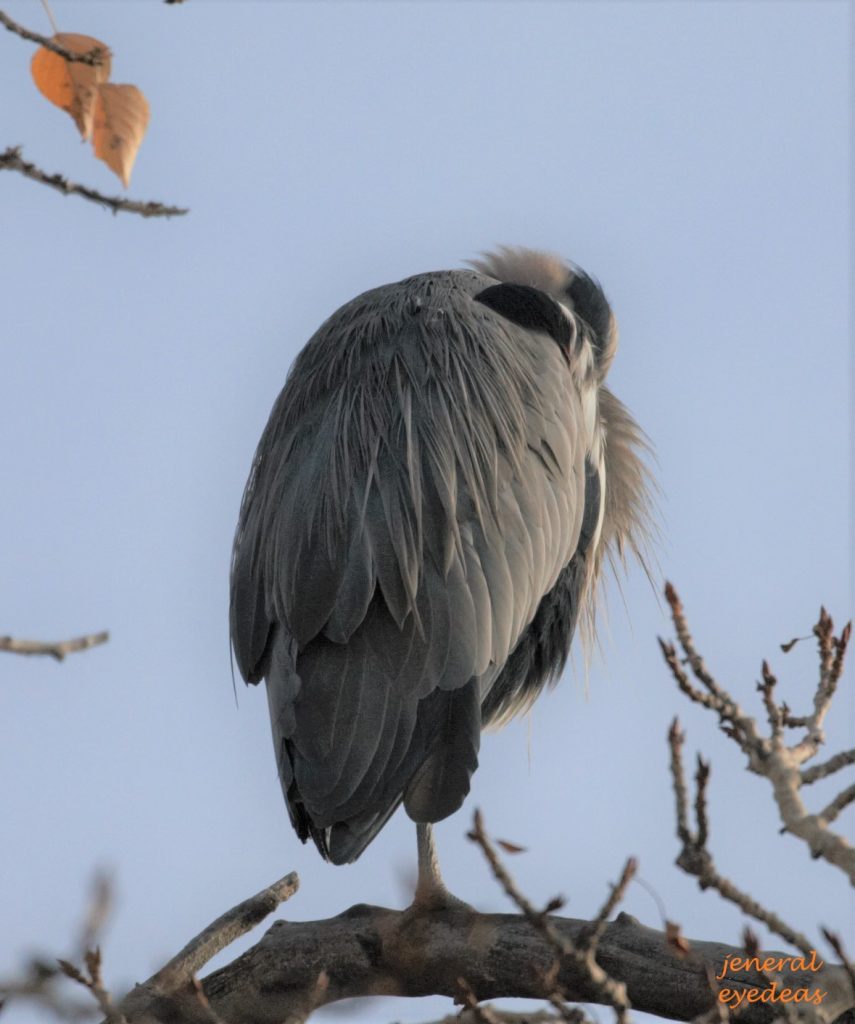
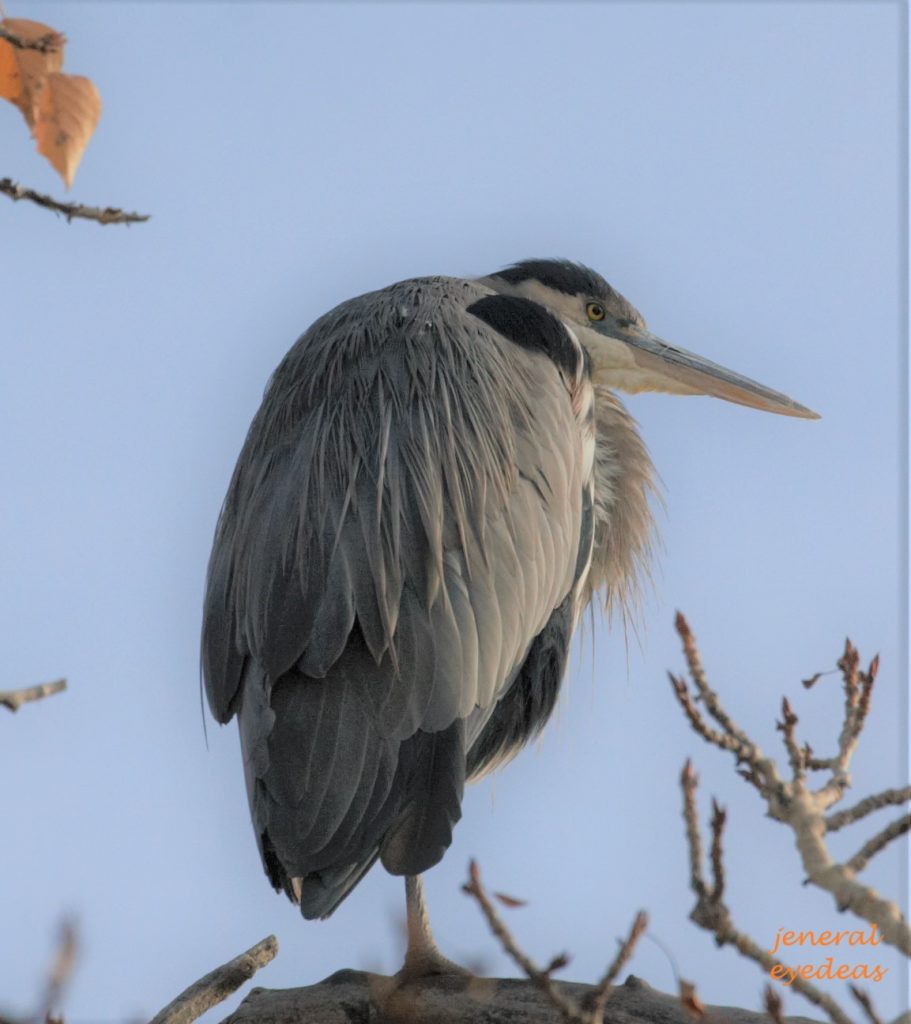
Ever wonder what a bird looks like when its roosting and all bundled up? I had the wonderful opportunity to see a Great Blue Heron snoozing and snuggled up while perched high up in a tree.
After breakfast one morning, I made my way to a nearby park with my camera, telephoto lens, and binoculars in tow. Upon arriving, I was one of maybe three people walking in the glorious golden glow of the morning light! It was a special treat to walk alone in silence listening to the sounds of different birds with the occasional splash of water in the lagoon. I scanned the shore line with my binoculars in hopes of seeing a Great Blue Heron. During my search, I saw about half a dozen Wood Ducks and about 20 mallards relaxing in the pond. A small banditry of Black-capped Chickadees and a couple Nuthatches could be heard in distance. I crossed a bridge to scan the other side of the shoreline when it dawned on me that I should also look up! An odd shape was perched in a tree and there it was, the magnificent Great Blue Heron roosting peacefully with its feathers fluffed out and head tucked into its chest. I walked quickly towards it in hopes of catching a photo in the lovely fall morning glow.
In my area, the beautiful heron can be seen until about late October to early November according to observations reported in ebird, but with the consistent freezing temperatures overnight I can imagine this bird may be regretting its decision to miss the early flight south! Hinterland Who’s Who explains Great Blue Herons have a broad range in Canada spanning from British Columbia to some of the Maritime provinces. This majestic bird flies south for the winter and some Herons who were banded in Canada have been found as far south as Mexico, Honduras, and Cuba! Great Blue Herons migrate alone or in groups as large as 100 either during the day or night! Birds, in general, migrate in the winter to warmer climates to have greater access to food resources.
When I photographed this magnificent Great Heron Blue in the morning, the lagoon in the sanctuary was not frozen, there were a few Wood Ducks bathing in the near sub-zero water! I watched the Heron roosting for several minutes. When there was a flutter of birds nearby or a possible alarm call, it would untuck its head and peer out for a few seconds. Once it perceived there was no danger, it quickly tucked its head back into a warm pocket of feathers. It is possible there is still food in the lagoon for the Heron to feed on. Whenever this feathered friend decides to fly south, may it have a safe, plentiful, and peaceful journey!
If you are curious to see what a Great Blue Heron looks like when it is visiting during the warmer spring and summer months, check out my blog posting titled Fascinated by Feathers and Flight.
Leave a Reply